The History and Politics Lab’s goal is, to use Toni Morrison’s words, to shed critical light on the “politics and history calculated to render the suffering of millions mute,” by refusing “arrogant pseudo-empirical language crafted to lock creative people into cages of inferiority and hopelessness.”
The lab, which is hosted by UC Irvine’s School of Social Ecology, is currently developing the following projects:
U.S. Concentration, Detention, and Internment Camps (DREAM Project). For many, camps such as Alligator Alcatraz represent an anomaly in American history. This project contradicts this common assumption. It offers the first database of U.S. concentration, detention, and internment camps from the First World War to the present day. Sub-projects include an oral history of the Temporary Detention Camp for Japanese Americans in Santa Anita, an ethnography of families whose members have been in ICE detention camps in California, and a theoretical article on what makes a camp a “concentration camp.” Participants currently include 7 undergraduate students, 1 graduate student, and 1 alumna.
History and Politics Virtual Community (Western Political Science Association, with Vikram Visana). Created in 2024, this virtual community aims to bridge political science and history through a series of online events for interested scholars worldwide. It has organized 10 events to date.
- “Freedom of Expression in the History of Political Thought,” with Kevin Pham (Amsterdam) and Ani Chen (Cornell), 2 April 2025;
- “Navigating History and Politics at Once: A Conversation with Duncan Bell,” 28 May 2025;
- Author-Meets-Critics Panel on Jeff Wasserstrom (UC Irvine), The Milk Tea Alliance (with Jeppe Mulich, Meredith Weiss, and Eraldo Souza dos Santos as discussants), 4 June 2025;
- Leigh Jenco (LSE), “Commoner Agency and Commoner Verse: The Generative Act of Transmission in Two Early Modern Examples” (with Simon Luo, NTU Singapore, as discussant), 17 June 2025;
- “Four Hands: A Conversation with Ryan Doerfler and Samuel Moyn,” 18 June 2025;
- Author-Meets-Critics Panel on Sam Klug (LUM), The Internal Colony (with Errol Henderson, Daniel Matlin, Erin Pineda, and Nazmul Sultan as discussants), 25 June 2025;
- “Navigating History and Politics at Once: A Conversation with Jennifer Pitts,” 15 October 2025;
- Sherene Seikaly (UCSB), “On the Question of Palestine” (with Khirad Siddiqui, UC Irvine, as chair), 10 April 2026;
- 1st Mini-Conference “History & Politics,” with a keynote speech by Marcus Lee (Princeton), 2 June 2026;
- Author-Meets-Critics Panel on Yann Allard-Tremblay’s Disjunctures: Indigenous Redirections in Political Theory (with Ritwik Bhattacharjee, Burke Hendrix, and Kouslaa Kessler-Mata as discussants), 12 June 2026;
- Author-Meets-Critics Panel on Shuk Ying Chan’s Postcolonial Global Justice (with Michael Luoma, Margaret Moore, and Cara Nine as discussants), 19 November 2026.
Brasil Initiative (CAPES, Ministry of Education, Brazil)
- Igor Simões (UERGS, Brazil), “Absent Presence: Afro-Brazilian Artists in the International Debate on Art and the African Diaspora” (organized with Sora Han, Department of Criminology, Law and Society, and co-sponsored by the Poetic Justice Cluster), 21–22 October 2024;
- Keisha-Khan Perry (Penn), “The Fire Inside: The Social Justice Imperative at the Heart of African Diaspora Studies,” 27 October 2025;
- Alex Ungprateeb Flynn (UCLA), Book Talk: Pathways to Utopia: Time and Transformation in the Landless Workers Movement of Brazil (organized with Abigail Lapin Dardashti, Department of History of Art, and co-sponsored by the Center for Latin American and Caribbean Studies).
- Miqueias Mugge (Brazil LAB, Princeton) and Victoria Bergbauer (Emory), “Empires of Fantasy and Fear: Unfree Migrations in the Age of Emancipation,” 10 March 2026;
- “Intimate Histories of Brazil: Family, Memory, and Echoes of the Past,” with talks by Daniel Silva (UFSC, Brazil), José Henrique Bortoluci, and Eraldo Souza dos Santos (organized with Jerry Won Lee, Department of English), 25 March 2026;
- “Also Known as a Black Samurai: Yannick Hara in Concert,” Co-sponsored by the Poetic Justice Cluster and the Illuminations Initiative, 6 April 2026;
- Conversations with Maurílio Martins (Filmes de Plástico, Brazil): “From One Street Corner to the Next: Cinema Inspired by Everyday Life,” 15 June 2026; “Memory and Resistance: Building an Independent Cinema in the Age of Artificial Intelligence,” 16 June 2026; The Last Episode, 17 June 2026;
- Conversations with Clayton Nascimento (Actor/Playwright, Brazil): Playwriting Workshop, 20 October 2026; Acting Workshop, 21 October 2026; From MA-CA-COS to A-PES: A Translation Workshop, 23 October 2026.
Critical and Interpretive Methods in Law and Society: A Workshop for Graduate Students and Early Career Scholars (2025 Advance Grant, Law and Society Association)
- Daniel Silva (UFSC), “Talking Back to the Law: A Workshop on Language, Rights, and Refusal in Brazil’s Favelas,” 5 June 2026;
- José Henrique Bortoluci (Creative Writer, Brazil), “Memory, Life Stories, and Democracy Beyond the Law,” 16 October 2026.
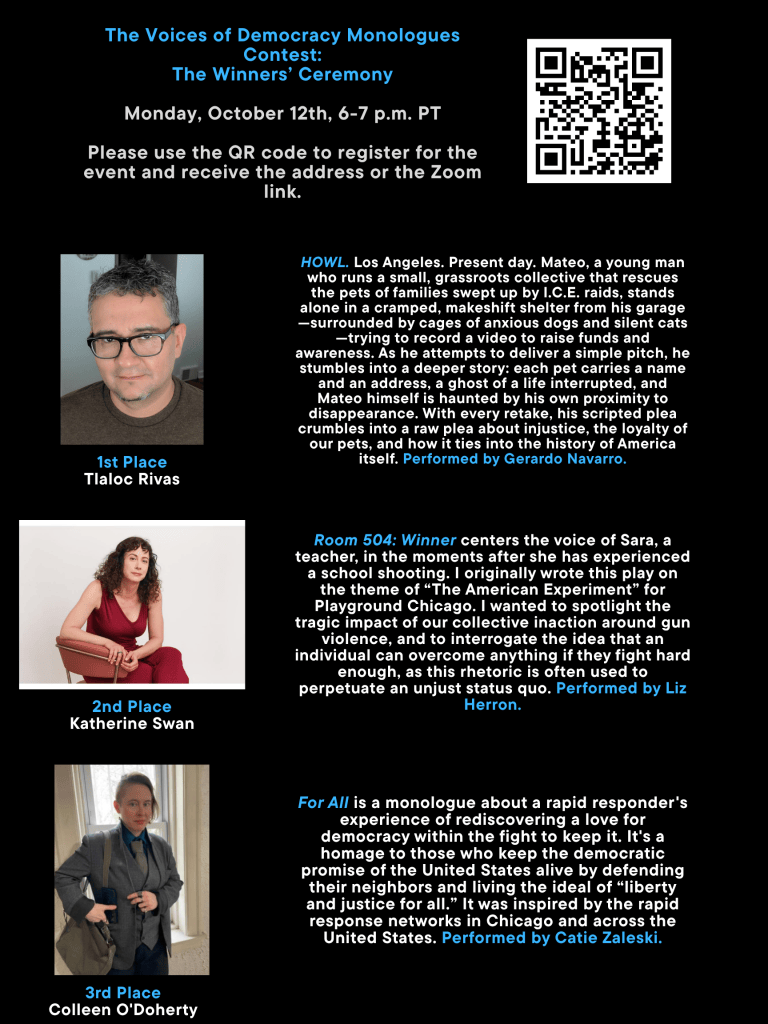
The Voices of Democracy: A Ten-minute Monologue Festival (2026 VOICE Grant, UC National Center for Free Speech and Civic Engagement). In Samuel Beckett’s groundbreaking play, Waiting for Godot (1953), Lucky, enslaved by Pozzo, remains silent throughout. But with one exception: when his master allows it, Lucky delivers a long, incoherent monologue that sheds light on his experience with unfreedom. Lucky is no exception in the history of playwriting and theater: Monologues have long given voice to the unheard and remain one of the most common genres for expressing challenges to free expression. In the United States, a long tradition of organizing festivals for ten-minute plays has gathered actors, directors, and playwrights from across the country each year. This project, funded by the Valuing Open and Inclusive Conversation and Engagement (or VOICE) Initiative of the UC National Center for Free Speech and Civic Engagement, will organize the first festival of this kind in the University of California system. An interdisciplinary group of UC students, professors, staff, and a vice chancellor, along with a group of external writers, reviewed about 100 submissions and selected three monologues to be staged at UC Irvine in October 2026.
The Plato Group (2027 VOICE Grant, UC National Center for Free Speech and Civic Engagement). In January 2026, Dr. Martin Peterson, a professor of philosophy at Texas A&M, was instructed to remove some readings from his “Contemporary Moral Issues” syllabus. Given the new anti-DEI policies of the federal administration, many were expecting professors who assigned readings on race and gender to be under scrutiny. What most did not expect, however, was that one of Plato’s dialogues, The Symposium, would become a target. Plato’s discussion of sexuality and homosexuality in that dialogue triggered a nationwide debate about the classics. It is well-known that many of the characters in Plato’s dialogues are gay men; many discussions initiated by Socrates, considered the founding father of Western philosophy, are about male beauty, for example. This has not impeded conservative and right-wing instructors from assigning Plato’s dialogues for centuries. In many schools across the country, Plato’s dialogues are among the “Great Books” that every student must read to understand American culture. But assigning The Symposium had a lasting impact on Dr. Peterson’s life. He eventually decided to resign from his position in April 2026, amid public pressure and threats. This project will invite UCI students to restage The Symposium as a gesture of freedom of expression and civic engagement amid efforts to censor it.
Praxis (2027 VOICE Grant, UC National Center for Free Speech and Civic Engagement). Praxis is a student-led publication founded by three undergraduate students at UC Irvine: Annabelle Hedrick (Criminology and Political Science), Leela Narayan (Social Ecology), and Salwa Usmani (Social Ecology and Business Management). It gives students a space to share ideas, research, and conversations that often begin in the classroom with a wider audience. Praxis publishes student and emerging scholar work through three main formats: op-eds, research pieces, and podcasts. UCI’s Department of Information and Computer Sciences (ICS) supports and administers the grant, and Dr. Eraldo Souza dos Santos (Department of Criminology, Law and Society) advises the project.

